
NZ caravan towing calculator
Use this free NZ caravan towing calculator to check your tow vehicle, caravan ATM, ball weight, towbar rating and estimated loaded weight before you hit the road. It's a practical sanity check for Kiwi touring — not a replacement for your handbook, compliance plate, weighbridge ticket or the legal limits.
Your towing setup
Result
Fill in your details and hit "Check my setup" to see a towing sanity check.
Your rig (visual)
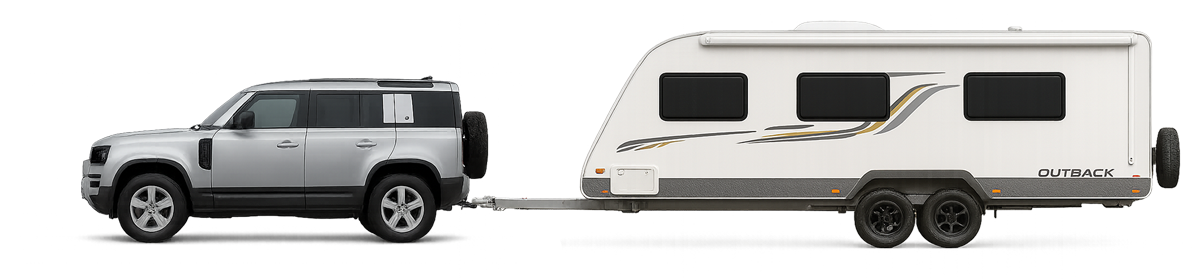
Once you've added your tow vehicle and caravan details, we'll show your current setup here.
Checks
Caravan weights – quick guide
| Weight | Your numbers | What it means |
|---|---|---|
| Tare (plate) | – kg | Empty build weight from the caravan plate. |
| ATM (plate) | – kg | Maximum allowed fully loaded weight on the plate. |
| Loaded (your estimate) | – kg | What you actually travel at – weighbridge or best estimate. |
| Typical ball band | – | Rule-of-thumb 8–12% band many NZ rigs aim for. |
| Your ball weight (if known) | – |
Important: TouringBrain uses rule-of-thumb guidance for NZ caravans and tow vehicles. It does not replace your vehicle handbook, caravan plate, or professional advice. The lowest rating (vehicle, towbar, hitch, tyres, caravan) always wins. Use a weighbridge to confirm real-world masses. All care, no responsibility.
How the New Zealand caravan towing calculator works
Working out whether your tow setup is legal and safe in New Zealand involves comparing five different ratings against three different real-world weights. The vehicle's braked tow rating, the towbar's rating, the hitch coupling's rating, the tyres' load index and the caravan's ATM all set ceilings. Your loaded caravan mass, ball weight and gross combined mass have to sit under all of them. The lowest rating always wins.
Touring Brain's towing calculator does that comparison for you. Punch in your vehicle's kerb weight and braked tow rating, the caravan's ATM and ball weight (laden), towbar and hitch ratings, and you'll get a clear "you're inside the limits" or "this combination is over" verdict — plus the specific rating that's pinching, so you know what to fix. It also surfaces the NZ-specific rules around Class 1 driver licence weights, where a heavy combination quietly tips you into Class 2 territory.
The calculator is rule-of-thumb guidance based on published NZ standards and common caravan-industry practice. It doesn't replace your vehicle handbook or the caravan's compliance plate, and it can't see your specific tyre load index. Treat it as a sanity check — and confirm real-world masses on a weighbridge before any long trip, especially if you've added solar, lithium batteries, an awning, full water tanks or fresh gear.
Frequently asked questions about NZ caravan towing
What's the maximum tow weight on a Class 1 NZ driver licence?
A standard full Class 1 (car) NZTA licence covers a combined vehicle plus trailer weight up to 6,000 kg GCM (Gross Combined Mass), with the trailer itself up to 3,500 kg GVM. On a learner or restricted car licence the weight of your vehicle plus the trailer must not exceed 4,500 kg combined. Above those limits you need a Class 2 licence. Most popular family caravans paired with mid-size SUVs sit comfortably under both — but heavy triple-axle vans behind a 4WD ute can edge into Class 2 territory faster than people expect.
How is ball weight (tongue weight) calculated?
Ball weight is the downward force the caravan exerts on your tow ball when level. It's usually 7–10% of the loaded caravan mass for European-style vans, and slightly more for traditional trailers. Too low and the caravan will sway in crosswinds; too high and you overload the rear axle of the tow vehicle. Weigh it directly with a tow ball scale, or weigh the caravan twice — once on its jockey wheel, once with the jockey wheel raised and the ball on a scale.
What's the difference between ATM, GTM, GVM and GCM?
ATM (Aggregate Trailer Mass) is the maximum weight of the loaded caravan when uncoupled — the absolute ceiling on the caravan plate. GTM (Gross Trailer Mass) is what's actually on the caravan's wheels when hitched (ATM minus ball weight). GVM (Gross Vehicle Mass) is the maximum loaded weight of the tow vehicle. GCM (Gross Combined Mass) is the maximum weight of vehicle plus loaded caravan together. All four are stamped on plates somewhere on the rigs.
What if I can't find a compliance plate on the caravan?
Older caravans — particularly imports and home-builds — sometimes have no plate or an unreadable one. In that case you'll need to weigh the empty caravan and confirm the chassis specs. NZTA's Vehicle Inspection Requirements Manual sets out the process. Don't guess: an over-mass caravan is a Warrant of Fitness fail and an insurance problem if you have a crash.
Does my tow vehicle need a Certificate of Fitness?
If your tow vehicle's GVM is over 3,500 kg, it usually needs a Certificate of Fitness (CoF) instead of a WoF, and the trailer always needs a CoF if its GVM is over 3,500 kg. Twin-cab utes and 4WDs paired with heavy caravans are the typical edge case here — worth checking with VTNZ if you're unsure.
Do I need anti-sway / weight-distribution hitches?
Not legally, but often a very good idea. Weight-distribution hitches level the combination and put more weight back on the tow vehicle's front axle, which improves steering and braking. Anti-sway devices (friction or electronic) help in crosswinds — useful on NZ's exposed alpine and coastal routes. Don't expect either to compensate for a fundamentally over-mass setup.
More tools for New Zealand touring
- Motorhome GVM check — same idea, different rig.
- Tyre safety check — DOT code age and load-based pressures.
- Pre-departure checklist — nothing forgotten before you hit the road.
- Plan a route — Loop, A→B with stops, or destination-mode trip planning.
- 3-day weather briefing — wind, rain and gust forecasts.
- Find NZ campsites & holiday parks — DOC and OSM data on a map.